Mar 20

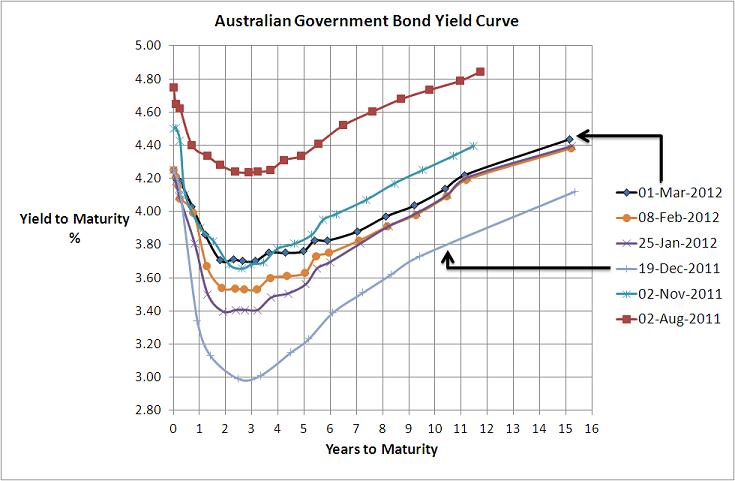
Australian Government Bond Yields…approaching normal

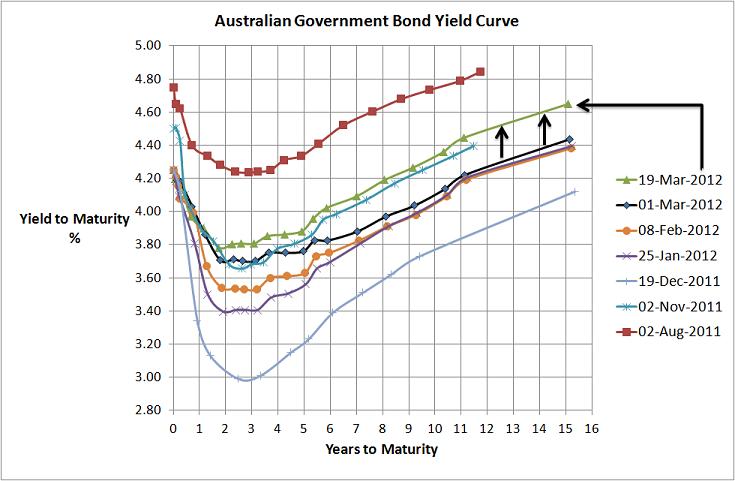
Well…not normal yet. The shorter part of the curve suggests the market is expecting another two 25bps cuts by the RBA but with the Euro sovereign crisis well and truly looking much better its highly unlikely there’ll be any cuts soon. Whilst there’s plenty of evidence that shows the Euro sovereign crisis has improved, nothing does so more than the decline in Italian 10 year bond yields from over 7% a few months ago down to 4.83% overnight…truly a good recovery to confidence but there’s still a long way to go.

Europe is undoubtedly in recession, the austerity programs are proving disastrous without anything to produce growth except hope…not much of a plan. Youth unemployment in Greece and Spain is over 50% and its getting up there in many of the other troubles European economies…there is little doubt that the social unrest we have seen in Greece in recent times will continue and it will ignite in other countries as well…Europe has all sorts of troubles and there’s a long way to go before normality exists.

The unemployment issue in the USA has definitely shown improvement over the last couple of months but keep in mind some of that is due to people withdrawing from the workforce which artificially deflates the unemployment result. Anyway, the jobs growth is still an improvement on last year, the decline in housing has stalled, and Bernanke is keeping rates at 0 for a couple more years. The biggest concern for the US is the continued withdrawal of government stimulus that will be an ongoing headwind to economic growth and I believe some of the Bush tax cuts are withdrawn in January 2013 which apparently will produce a 3% hit to GDP….plenty of headwinds.

As for Australia, my personal view is that the overall economy is going ok but the headlines that I’ve been reading suggest that our low unemployment levels will be at risk. With our housing market and sharemarket declining over the last year, household wealth is down; if unemployment spikes then this could be a psychological hit to our confidence that we haven’t seen for some time. I’ll be keeping an eye on unemployment.

As for markets, despite the increase in the sharemarket this year, I’ve seen enough to increase my longer term weighting to risky assets. I do believe volatility is still too low, but I’m more comfortable with the longer term outlook for shares than I have been for a long time (can’t remember when to be honest). As for government bonds…as the above chart shows, the yield increases means the prices have decreased and its not where I want my long term money to be today. So yep, I’m giving the kiss of death to risky assets and am more comfortable to increasing their allocation than I have been for ages.


Mar 15

Having a crack at Goldman Sachs

Yesterday, the New York Times published details of a resignation letter of a very senior Goldman Sachs employee who totally ripped into the culture and product flogging mentality of Goldman Sachs. For anyone interested in the letter, whcih is quite an entertaining read for those of us in the industry, here it is… Goldman Sachs Letter.

Of course Goldman Sachs issued a reply denying the accusations but I’m sure the damage is done.


Mar 13

Corporate Bond ETF or Big 4 Bond ETF????

I was quite excited to see the launch of the new Russell Select Australian Corporate Bond fund over the past few days. I thought the ability to have a diversified Australian bond fund that has the ability to provide a bit of credit risk for a more diversified portfolio would be great.

Unfortunately when I looked at the portfolio the holdings were the following…

  • COMMONWEALTH BANK AUST …maturing 20 Feb 2014
  • AUST & NZ BANKING GROUP …maturing 10 Nov 2014
  • WESTPAC BANKING CORP …maturing 18 Aug 2014
  • WESTPAC BANKING CORP …maturing 18 Nov 2014
  • NATIONAL AUSTRALIA BANK  …maturing 19 Dec 2013
  • AUST & NZ BANKING GROUP …maturing 16 Jan 2014
  • WESTPAC BANKING CORP  …maturing 05 Mar 2014
  • COMMONWEALTH BANK AUST  …maturing 14 Jul 2014
  • NATIONAL AUSTRALIA BANK  …maturing 16 Sep 2014
  • COMMONWEALTH BANK AUST …maturing 21 Jul 2015

Oh well…not too diversified…just the big 4 banks…bummer, and back to the drawing board for me…I’m afraid at this stage Russell’s should look to rename their ETF to something that reflects the underlyings a little more closely.

Mar 10

SPIVA…Australian Small Cap managers demonstrate skill

The SPIVA report was released a few days ago and as I’ve mentioend before it is my favourite assessment of the success of fund managers because it takes into consideration survivorship bias…in other words, if you want to know who are the best fund managers over the last year, then you start with all fund managers from one year ago and assess all of them as opposed to assessing the fund managers who are left (and therefore have survivorship bias).

Anyway, I digress…if you want the SPIVA report just click here.

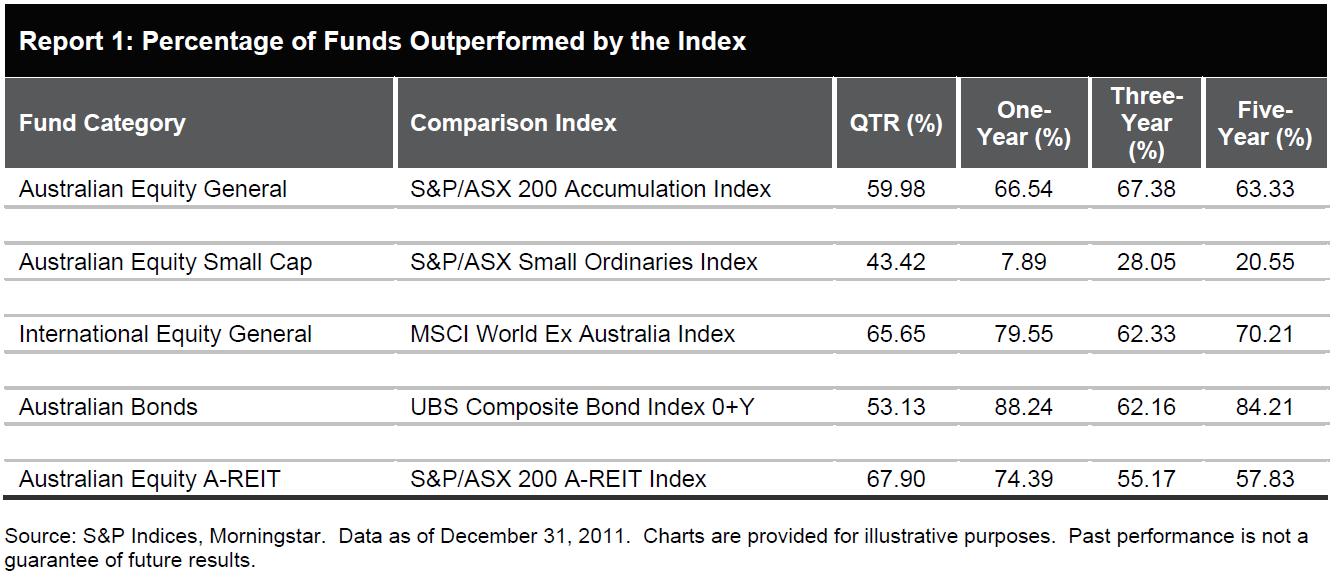
In terms of success of Australian fund managers, as Report 1 shows it appears that only Australian Small Cap Equity managers consistently have the ability to outperform their respective index with almost 80% of managers doing so over the last 5 years.

Source: Standard and Poors

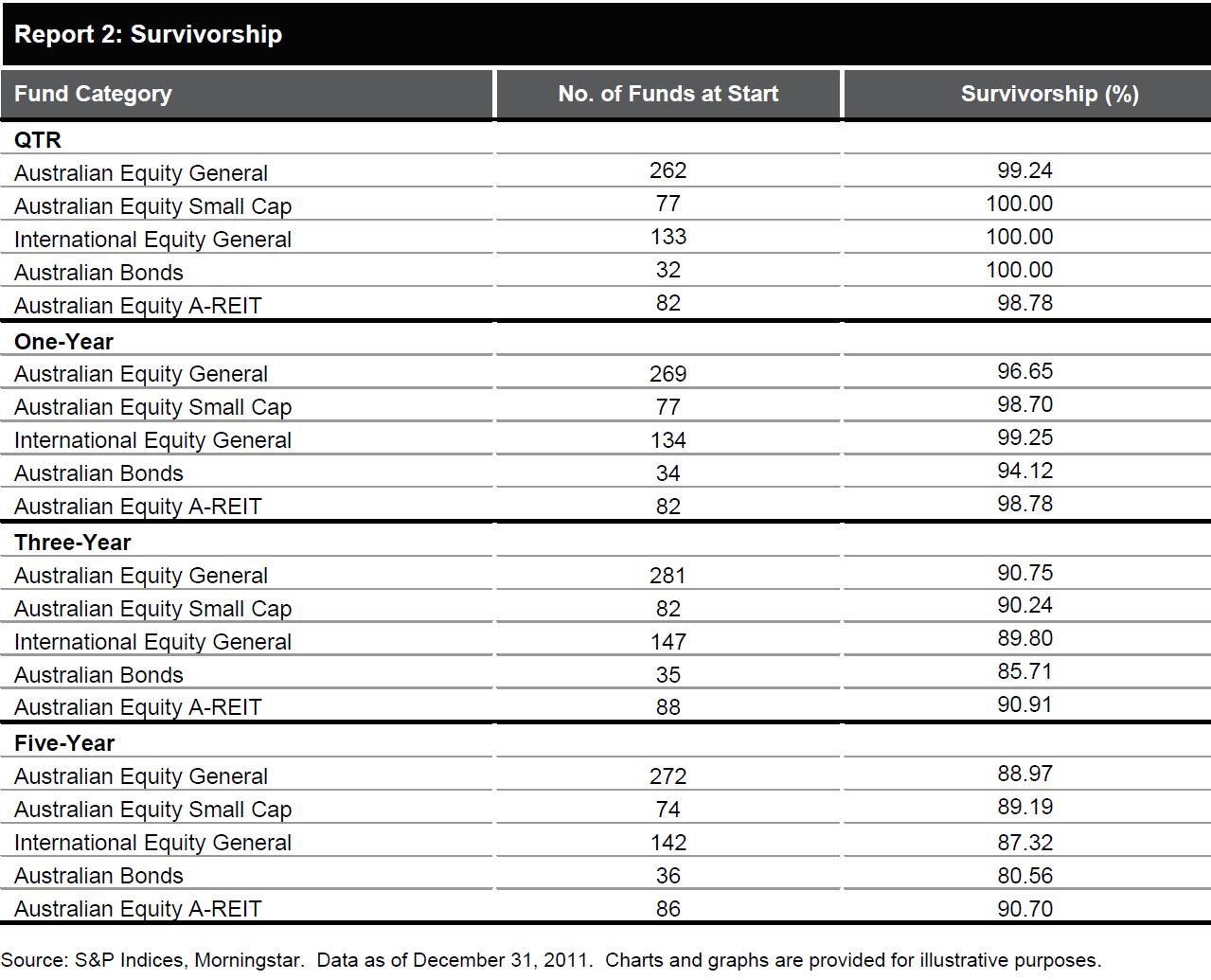
Report 1 also shows that Australian bond managers have really struggled to outperform the UBS Composite over the last 5 years with more than 84% failing to do so. As a result its unsurprising to see Australian bond managers have the lowest level of survivorship…Report 2 below shows the last 5 years saw almost 1 in 5 managers drop out of the performance race (i.e. 80% survivorship).

Source: Standard and Poors

OK, so what does this mean? Does it mean you should buy index funds over actively managed funds for every asset class except small cap Australian equity?or forget managers and do it yourself?

The SPIVA report and the above results certainly mount an outstanding case for the index manager. There are numerous research houses out there who believe that it is possible to pick the good active manager who can beat the index but unfortunately these research houses haven’t been held to account for their predictions and we don’t really know if they truly are successful manager pickers. Whilst there are many active managers with demonstrated outperformance over long periods of time, unfortunately the longer they survive the lower their probability of performance persistence as increased funds inflow make it more difficult to execute best ideas.

Jeremy Grantham in his longest ever quarterly newsletter suggests the do-it-yourself route, but there are serious caveats that I absolutely agree with…such as,

If you cannot resist temptation, you absolutely MUST NOT manage your own money.

My thoughts have been and continue to be that, with the exception of the small cap manager, the large cap equity or bond index manager should have a prominent place in all diversified portfolios due to their low cost, transparency, simplicity, and the fact you pretty much know what return you will get…i.e a little less than the index. I do admit that I’m concerned with the longer duration of the bond index and my belief that duration is not the best long term place to be but nevertheless, that makes me an active manager and I might be wrong!

I believe active managers have a definite role in diversified portfolios but they should be considered as having increased risk (i.e. underperformance risk) and therefore the use of active managers (or direct undiversified portfolios like stock portfolios) should increase in line with the risk profile of the investor.

Mar 06

Australian Bond Yields…still edging up

Source: RBA

I know the above chart is a couple of days old but there’s not much change since last Thursday. At its simplest what it shows is that the bond market is still expecting the Reserve Bank to decrease interest rates some time during the year…with 1 year bond yields at less than 4%, the market still expects at least one and may be two interest rate decreases some time this year.Despite that, results of a survey of 24 economists overnight showed that every one of them believes that rates will stay on hold today.given the stabilisation of many economic factors both here and overseas I have to agree.

The big issue, of course, is still Europe and the Greek default (or whatever you want to call it), won’t occur until later this month and that could very well create some market volatility. I say that because whilst we already know what is most likely to happen there is uncertainty in terms of what will happen with Credit Default Swaps (or default insurance) that many hold on Greek debt…will they be triggered or not and if so, what will be the financial consequences in the shadow banking system….the last week of March may be interesting.

Anyway, back to the chart, given bond yields bottom at 3 years and 10 year yields are still fairly low, still suggests that the Australian economy is unlikely to shoot the lights out and inflation is well contained for the moment. The creeping up of the yield curve is a reflection of a quiet month of economic news…no news is good news.

Moving forward I believe the most important local economic indicator will be unemployment. Obviously Europe will have the biggest short term impact on sharemarkets, but if our unemployment level increases significantly this may flow into weaker confidence, even lower house prices, and therefore lower GDP growth. Given all of the cutbacks announced I’d be very surprised if unemployment doesn’t go up but its the sharpness of that increase that will be critical.

In terms of investment its still  very difficult environment. Bond yields are very low ad sharemarkets still have numerous macro risks hanging around and a low growth economic environment and high Australian dollar may limit A-REIT’s upside so its a very tough call (of course term deposis continue to pa attractive margins over bonds). My pick at the moment is volatility…I’m very confident it will increase from these curent low levels so if I could easily invest in volatility (which I can’t) then I would.

Mar 04

Portfolio vs Asset Allocation…potential pitfalls

Many financial planners recommend their clients follow a particular Strategic Asset Allocation that may be based on the output of the combination of a risk profile as well as matching the client’s needs. For example, a popular strategic asset allocation for a “balanced” portfolio may be along the lines of…

  • Australian Shares 35%
  • Global Shares 25%
  • Property 10%
  • Bonds 20%
  • Cash 10%

or in simple terms, the “balanced” portfolio contains 70% ‘growth’ assets and 30% ‘defensive’ assets (i.e. cash plus bonds). Whilst this overall asset allocation appears simple enough, unfortunately when the underlying investments are chosen, inadvertently, they often increase the portfolio risk beyond that of the Strategic Asset Allocation’s risk. This is because the overall risk of the Strategic Asset Allocation is based on broad-based indices but our investmen portfolio may significantly deviate from them…for our “balanced” asset allocation the indices may be…

  • S&P/ASX 200 Accumulation index
  • MSCI World Index (Unhedged)
  • S&P/ASX 200 A-REIT Accumulation Index
  • UBS Composite All Maturities
  • UBS Bank Bill

…but our portfolio may contain Australian shares outside the top 200, or may have high exposure to Emerging Markets or exposure to Growth Shares. Also, perhaps the property allocation contains global REITs, and the fixed interest has a high proportion of credit. There may be other risks in the portfolio from hedge funds, long/short funds, commodities, or perhaps a very high proportion of mezzanine finance. If an investment portfolio contains these exposures then whilst they may add up to the stated proportions of the Strategic Asset Allocation, compared to the above-mentioned indices the final portfolio will undoubtedly carry significantly more risk…and also more cost from higher than index fees.

So if risks are embraced over and above the Strategic Asset Allocation’s, then it may require an increase in allocation to the more defensive allocation of cash and bonds. If credit is added to the portfolio, reduce some equities or property; if there is a large small cap allocation in Australian Shares, perhaps the overall Australian shares allocation needs to be reduced.

So please keep in mind that a recommended Strategic Asset Allocation is based on cheap simple index funds and if your portfolio has different risks to these traditional indices then it may have more risk than you realise…more return potential sure, but more loss potential too.

Mar 01

A Letter from Zilch Capital…

This link from The Economist was passed onto me today and is a hilariously written letter from a fictitional hedge fund manager to its investors. I have reproduced the full letter below (I hope The Economist doesn’t mind) …

Dear investor,

In line with the rest of our industry we are making some changes to the language we use in our marketing and communications. We are writing this letter so we can explain these changes properly. Most importantly, Zilch Capital used to refer to itself as a “hedge fund” but 2008 made it embarrassingly clear we didn’t know how to hedge. At all. So like many others, we have embraced the title of “alternative asset manager”. It’s clunky but ambiguous enough to shield us from criticism next time around.

We know we used to promise “absolute returns” (ie, that you would make money regardless of market conditions) but this pledge has proved impossible to honour. Instead we’re going to give you “risk-adjusted” returns or, failing that, “relative” returns. In years like 2011, when we delivered much less than the S&P 500, you may find that we don’t talk about returns at all.

It is also time to move on from the concept of delivering “alpha”, the skill you’ve paid us such fat fees for. Upon reflection, we have decided that we’re actually much better at giving you “smart beta”. This term is already being touted at industry conferences and we hope shortly to be able to explain what it means. Like our peers we have also started talking a lot about how we are “multi-strategy” and “capital-structure agnostic”, and boasting about the benefits of our “unconstrained” investment approach. This is better than saying we don’t really understand what’s going on.

Some parts of the lexicon will not see style drift. We are still trying to keep alive “two and twenty”, the industry’s shorthand for 2% management fees and 20% performance fees. It is, we’re sure you’ll agree, important to keep up some traditions. Thank you for your continued partnership.

Zilch Capital LLC

Source: The Economist

Feb 26

Jeremy Grantham’s latest Must-Read

Jeremy Grantham’s latest quarterly newsletter is on the GMO website and as usual it is an educational, pragmatic and brilliant read. There is so much to take away from this one. There are three parts to his ‘longest quarterly letter ever’…

1. Investment advice from your Uncle Polonius

…which contains 10 absolute must read points. One of my many favourite bits …

To be at all effective investing as an individual, it is utterly imperative that you know your limitations as well as your strengths and weaknesses. If you can be patient and ignore the crowd, you will likely win. But to imagine you can, and to then adopt a flawed approach that allows you to be seduced or intimidated by the crowd into jumping in late or getting out early is to guarantee a pure disaster. You must know your pain and patience thresholds accurately and not play over your head. If you cannot resist temptation, you absolutely MUST NOT manage your own money.

2. Your Grandchildren have no value

part of his conclusion in this different perspective is…

Capitalism, by ignoring the finite nature of resources and by neglecting the long-term well-being of the planet and its potentially crucial biodiversity, threatens our existence. Fifty and one-hundred-year horizons are important despite the “tyranny of the discount rate,” and grandchildren do have value.

3. Investment Observations of the New Year

He provides his market outlook for short, medium and long-term and I won’t spoil what his specific calls are other than he is bullish, bearish and fair value…but not in the same order…sorry about that

Jeremy Grantham is undoubtedly one of the deepest thinkers in the investment world and his quarterly letter is a must read for anyone who wants to better understand the potential impacts of the major issues of our world on investment markets. I know its a long read, although at 15 pages its not really long as you’ll get more out of this than virtually any book you’re likely to find on investing.

Feb 24

I always like a good interest rate or yield

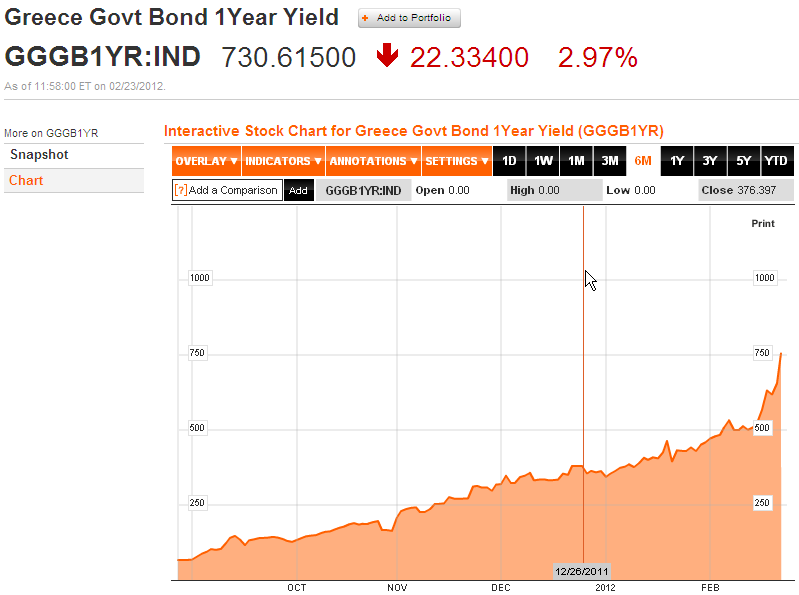
Unfortunately whilst the yield on Greek 1 year bonds is high at 730% (yes there’s no decimal point), it can hardly be described as good. When you have a 730% interest rate on your 1 year loan, its pretty safe to say that your chances of paying it back are zero. I understand why Greece is being bailed out (essentially to avoid a Lehman’s type contagion on banks and markets) but default is inevitable.

The fiscal austerity that is being imposed on Greece will reduce government expenses but will do absolutely nothing to increase government revenue…this is a requirement for Greece to recover. So the Greek situation will just get worse as revenues continue to fall due to continued vicious cycle of higher unemployment and lower consumer expenditure and for government that means lower tax revenues and higher debt requirements and therefore continued higher interest rates.

I originally put this chart up because I found it somewhat of a joke, but its not a joke at all, its actually a nightmare for many innocent people.

Feb 20

Excellent long term performance from bonds…but there’s a lot more to it

A look at the average returns of bonds over the last 30 years does not suggest that equity returns have really been worth the risk. Table 1 shows the returns on Australian Bonds (Aust Comm Bank All Series/All Maturities) versus the accumulated return of the Australian sharemarket (S&P/ASX 200 TR) and whilst equities have the better performance over 30 years its hard to imagine the additional 1.53%pa return has been worth the additional risk.

Table 1

Source: iRate van Eyk Research

Looking ahead many investors will see these returns and conclude that bonds are a better investment than shares, but unfortunately they won’t be looking at the full picture.

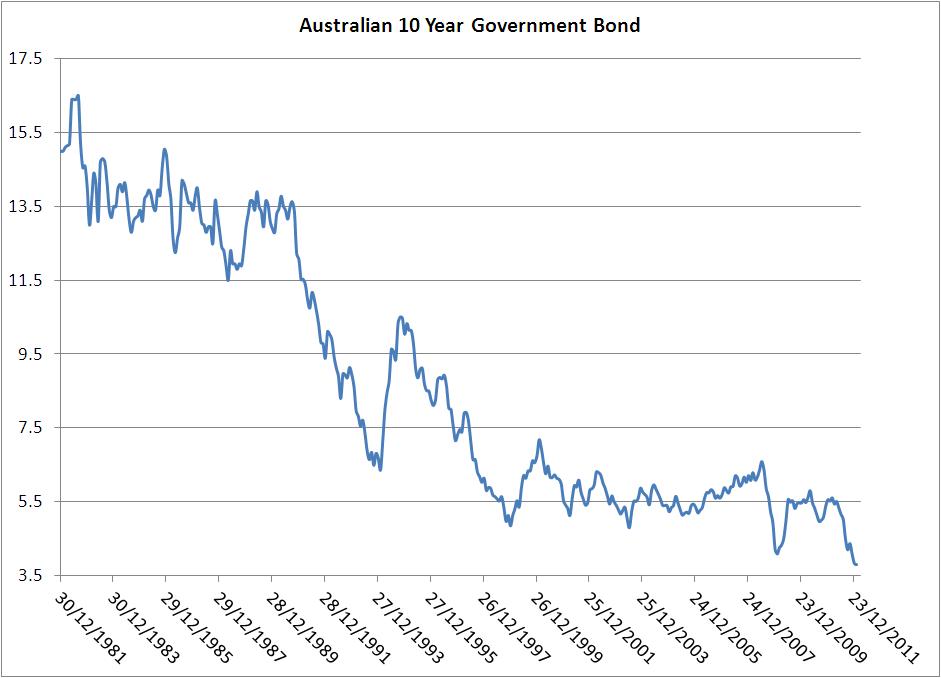
The below chart shows exactly what has happened to long term interest rates over the last 30 years and the trend is pretty obvious…its significantly down. So 30 years ago, an Australian 10 year government bond was yielding around 16.5% and now it yields below 4% which is a significant drop. This means that over this time there has been a strong capital gain by holding bonds (when interest rates drop, bond prices go up) so the question is, will this trend continue?

Whilst it is absolutely possible that longer term interest rates (or yields) continue to drop, evidenced by Japan, US, UK and Germany whose 10 year bonds are 2%pa at most, over the longer term you would have to expect that return potential favours equities.

As I mentioned in an earlier post, the forward expectation of returns over the next 5 year for a bond fund is approximately the 5Year bond yield plus around 0.5% of credit risk, which equates to somewhere between 4% & 4.5%.I’m pretty confident that for the market as a whole that is not a particularly attractive return so the ongoing attractiveness of bonds may be challenged.

Whilst I do believe, that the macro economic risks should keep the prudent investor underweight risky assets for the moment, I am failing to see a compelling story in favour of boring old bonds. Term deposits are offering a very nice margin for the retail investor and corporate credit (for non-banks) appears attractive given cashed-up corporate balance sheets, but traditional asset allocation models are looking a little challenging.

The one issue that is in the back of my mind in favour of bonds, despite the macro risks, are potential structural changes in the Australian superannuation system. MySuper may result in far more conservative default funds as trustees realise the balanced fund is completely inappropriate, and the transfer out of the old default funds could be sped up by the introduction of superstream as well as the mass retirement of the baby boomer segment. Either way, the average Australian super fund carries a little more risk than it possibly should so I expect it to change over the years to come.

Back to my main point…equities look frightening, bonds look expensive, and cash is on the way down…its time to start looking at some non-traditional (sub) asset classes to diversify into.

Older posts «

» Newer posts