Feb 18

RSS Feed not currently working

Since I changed the look and feel of Fureyous, it appears the RSS Feed has ceased to work so my apologies for those of you who receive notification of posts via RSS.

I am currently working on fixing it and will advise by updating thispost once it is working again.

I made an attempt a little earlier but it brought the whol site down so I need a better solution than the first.

Stay tuned!

Feb 16

Platinum Asset Management…they’re good but also a tad greedy

Platinum Asset Management is undoubtedly the most successful International shares manager in Australia. Their long term performance is way above global benchmarks and thanks to this, their support has been unwavering and they have grown and grown to be one of Australia’s largest fund managers with over $18 billion in FUM.

Unfortunately like most companies their primary focus isn’t necessarily their customers. The Chairman’s address at their AGM a few months ago said,

The Board’s highest priority has been to ensure the focus of the investment management team continues to be on client’s returns

…its a pity they didn’t attribute that priority to whoever sets their fund’s pricing.

Sure their performance is pretty good as the performance of the Platinum Internation Fund demostrates below. But when you earn Profit before tax of $213m on Revenues of $264m (or a gross profit margin of 81%!!!), something tells me they may be a little greedy. so overall I’m really struggling to believe that their fund investors are a high priority.

Source: van Eyk Research

Whilst profit margins are 81% for shareholders, despite their benchmark relative strong performance…their investor clients can’t claim profit margins anything like it…and never will. Given the staff also own a lot of Platinum stock I’m fairly confident failure to perform in the future shouldn’t worry them too much financially and the stickiness of the funds in Platinum is likely that profitability will never be threatened. Which is not necessarily a bad thing, but surely there comes a point when its time to give back to those who have supported you for so long.

So…I know this is a big call as many advisers and their clients are very very loyal to Platinum, but perhaps there are some other global fund managers out there that may be a little hungrier and fairer to their client investors. Perhaps its time to change.

Feb 11

Performance Reviews…and I don’t mean investment performance

I know this is a finance-related blog but I’m compelled to vent about something that has bugged me my whole career…the dreaded annual performance review…anyway…

I was just readng Felix Salmon’s latest post, and found a sentence that I always believed in but thought I was the only one (mainly because it was just personal observation as opposed to owning any actual evidence)…

There is absolutely zero evidence that frequent, rigorous performance reviews ever do any good, and quite a lot of reason to believe that they actually do harm.

The link in Salmon’s sentence takes you to an outstanding articulate logical explanation of the failure of the annual performance review…music to my ears.

Key points…

  • Two people, two mindsets…the employee is thinking career progression, job progression and salary increases whilst the boss is picking holes in performance that could be improved
  • Performance doesn’t determine pay…although I do believe it might determine size of bonus but I found out last year even that isn’t always true (I’m still pi**ed about that)
  • Objectivity is subjective…let’s face it, two different bosses more often than not would conclude differently on one’s performance (often its a personality contest)
  • One size does not fit all…unfortunately the performance review is focused on a pre-determined checklist that may sometimes have little correlation to the true performance
  • Personal development is impeded…thanks to the performance review the boss is often the last person one goes to when they need help…wrong behaviour
  • Disruption to teamwork…the performance review has the tendency to undermine the teamwork aspect between boss and employee
  • Immorality of justifying corporate improvement…I think we all know that the performance review actually adds nothing to the bottom line of corporate performance.

The proposed solution is a “two-sided, recriprocally accountable, performance preview”…this implies that the performance of the employee is accountable to the boss, whose job it is to help, guide, and coach not the one-way, employee acountable method that dominates today.  This provides an environment where the focus is “about problem solving and not problem creating”…read the article for better justification than I can provide in a few words.

Personally, I couldn’t care less, and never have, about my performance review…I know how I’m going and always have and I’ve just wanted to get on with my job and do the best I can. The performance review has always been an annoying distraction to my day. If things aren’t going well, then the performance review is way too late, and my boss would or should have been communicating this to me way before.

Now if I can only convince my employer to ditch the performance review…mmmm…or perhaps I need to be the employer. 😉

Feb 10

Don’t forget the E in PE

Source: RBA

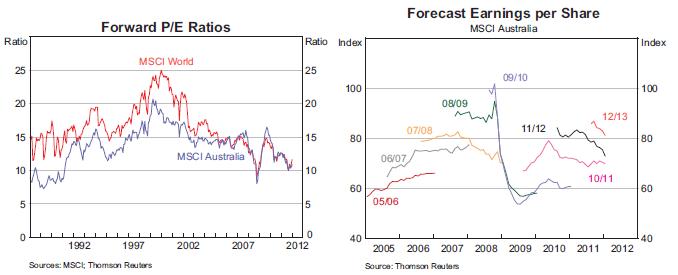
The above left chart, Forward PE Ratio, shows that the Australian sharemarket is potentially relatively cheap at the moment. The forward PE ratio, which is the ‘current price’ of the Australian sharemarket divided by forward estimates of earnings, has only been lower during the GFC and the 1990-91 recession ‘we had to have’. So on that basis alone, it appears that Australian shares may be worth buying.

However, the concerning part of that equation comes from the chart on the right, where the black line labelled 11/12 is trending sharply down. So whilst we may believe the “price” is low based on the PE ratio, the reality may be that it is “forecast earnings” are high. As forecast earnings decrease, the Forward PE Ratio will increase independent of price, and eventually may not look so attractive any more. Over the last 12 months analysts have consistenty decreased their forecast earnings for the Australian sharemarket and the current trend does look a tad worrisome.

So before you consider that a sharemarket is cheap (or hear it from a fund manager!) because the Forward PE Ratio is low, please consider whether forecast earnings are too high and likely to decrease….which is easier said than done…as the PE Ratio is a dangerous measure to be used alone.

Feb 09

Australian Government Bond Yields…still creeping up

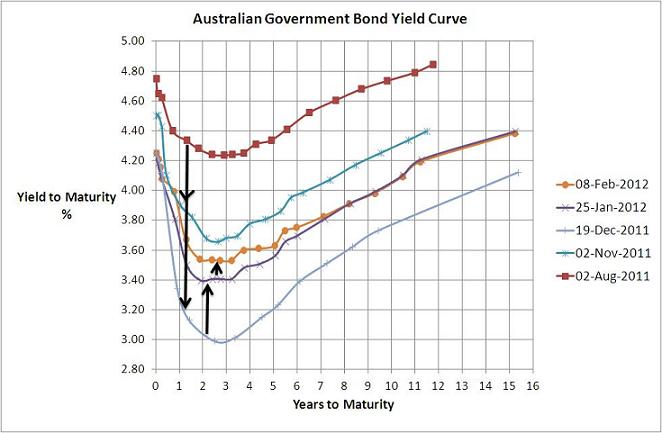
When I saw the headline in the Market section of today’s Australian Financial Review I thought bond yields must have gone through the roof but the above chart shows that there ‘s only a relatively small increase compared to a couple of weeks ago. Markets had obviously priced in a rate decrease from the Reserve Bank and when it surprised by leaving rates on hold the market had to readjust…hence the shorterm term yields increasing by up to 10bps.

Yields still aren’t quite up to November levels and the market is still not at all bullish on the Australian economy. The movment from the December lows are support for the ‘green shootswith overseas data…US finally had an actual decent employment month and Spanish & Italian bond yields are still trading far below their catastrophic levels. Long way to go so there’s still no harm staying underweight risky assets as the downside still appears to be greater than the upside this year.

Feb 07

A little bit of Bond misinformation

I was just reading the latest riveting story on bonds in this month’s Asset magazine and I feel compelled to share an example of misinformation that tends to annoy me a little (I know its probably a little pathetic but anyway)…John O’Brien, van Eyk – Head of Research, apparently said that

many of the great developed nations are now in trouble…citing Standard and Poor’s recent downgrade of the US federal government from AAA to AA+ in August last year and the downgrade of Japan’s credit rating

mmm…whilst I agree that both Japan and the US have debt levels that are uncomfortably high, I believe some clarifying facts are appropriate.

Firstly, when Standard and Poor’s downgrades government debt from AAA to AA, statistically that means that the probability of default increases from 0.01% to 0.07%…that’s two decimal places and then a percent sign. So the chances of default according to S&P increase from around 10,000 to 1 to 1,400 to 1! oooohhh…scary. So from a pricing perspective that should result in a widening of the yield by 0.06% or 6bps…to be honest…woopee do.

Secondly, before the S&P downgrade US 10 year bonds were yielding around 3%…now they’re around 1.9%…how’s that for market confidence. Following the downgrade the market started buying up an enormous amount of US government bonds.

Finally, Japan’s S&P downgrade was in 2002 (2002 is not a misprint)…we’ve obviously forgotten about it because their 10 year bond yield is a frightening 0.97%!!! How awful…imagine paying that rate on your mortgage.

Bad example John…perhaps you should have used Germany, oh, hang on their 10year bond yield is 1.9%…or maybe the UK …oops, they have a 10 year bond yield of 2.1%.  The market sees little credit risk there too.

Bottom line, with the exception of the well-documented PIIGs, the major government bonds of the world are showing very low yields that, according to the market, are not in the slightest bit concerning in terms of default or credit risk. That’s not to say they don’t carry risk as there is certainly a reasonable chance of yields increasing, resulting in capital losses, on the back of improving economic sentiment. Certainly, in the US the latest unemployment figures are positive and markets are much more comfortable with Italy and Spain debt and this has flowed into positive equity markets and a sligt  turnaround in confidence.

Anyway,  in my opinion, John gave a bad example in explaining the main risk of bonds because at the end of the day an S&P downgrade is often a little late and more often than not, meaningless.


 

Feb 03

A Must Read on “The Economic State of Australia”

Can’t believe I missed this…one of the finest finance thinkers around, Satyajit Das, has a blog entry on Economonitor discussing the current risks of the Australian economy…please click here for Part 1 and here for Part 2. So these are the must read, not Fureyous… 🙂

In these articles Das eloquently articulates the major influences on the Australian economy (China, Europe, Cost of funding, commodites, etc) and breaks down how these could play out.  I enjoyed his comments on why Australia handled the GFC better than others

APRA and politicians take credit for the banks being relatively unaffected (during the GFC). This is curious given that banking regulations are largely uniform around the world. One can only assume that Australia has superior regulators and politicians to the rest of the world – an example of “Australian exceptionalism”.

In reality, Australia’s swift recovery was driven by large cuts in interest rates, government guarantees for banks, government stimulus and a commodity boom

and his concuding remarks cannot be discounted

Australia remains vulnerable. A slowdown in Chinese growth and fall in commodity prices and volumes would affect the economy adversely. Australian history suggests that mining booms are finite and end suddenly causing significant disruption.

Problems in sovereign debt and attendant pressures on banking system may decrease available funding and increase borrowing costs for Australian banks and companies. Overvalued house prices and high household debt increases vulnerability to an economic slowdown, with an accompanying rise in unemployment or to higher mortgage rates. A credit crunch or recession could cause house prices to fall worsening domestic conditions, which would in turn affect domestic banks.

The perfect storm for Australia would be the coincidence of those events.

Das mentions the key positives for Australia, which are our low levels of  government debt, interest rates with room to move, and the abillity for our currency to significantly depreciate. However the complacency that I believe exists in this country that I’m unsure we ackowledge is that just because we made it through the GFC and have had 20 years of consistent economic growth without a technical recession…

Australia’s economy remains vulnerable to a variety of external factors over which it has no control.


Feb 02

ASX200 to go through 5000!!!

Perhaps haven’t been reading enough but I’ve just read my first article of the year with a fund manager suggesting huge returns for the Australian sharemarket…click here. Apparently the Platypus CIO believes the ASX200 ‘looks set to finish 2012 over the 5000 mark”.

At last check the ASX today was 4267 so ifit grows to 5000 by the end of the year that’s a capital gain for the remaining months of a little over 17%. Throw in a conservative dividend yield of 4% and that’s a 21% return!!! I love to hear the big calls

Sure, if the European and US economies look to be sorted and China’s issues are fine then 5000 is very do-able…I hope he’s right…but it is a big if and there’s a long way to go before we should be remotely confident of a 21% return this year so be very careful of what fund managers say…perhaps there may be conflicting reasons? 😉

Jan 29

Australian Government Bond Yields…continue slight improvement

Source: RBA

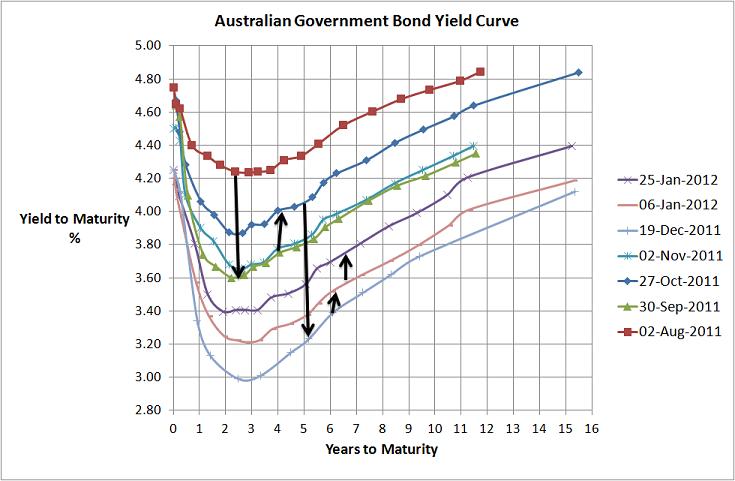
Its been a few weeks since I provided an update on the local government yield curve and consistent with the slight improvement in the sharemarket the Australian Government Bond Yield Curve has indicated a better outlook for the local economy. As the chart shows, since 6 January the yield curve has increased around 20bps across all maturities which isn’t a bad increase but yields still aren’t as high as they were last November.

Current figures still suggest the Reserve Bank will decrease its cash rate next meeting and the shape of the curve is consistent with weaker economic outlook suggested by the IMF and World Bank reports. It also suggests that inflation continues to be a non-threat and the ABS inflation figures showed that the market was pretty much correct by dismissing inflation over recent months.

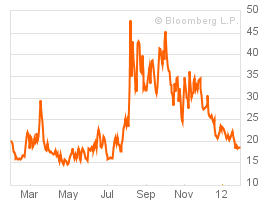
Since October the S&P500 has rallied around 20% in the face of some pretty ugly political behaviour in both the US and Europe regarding their respective economies and that’s quite a surprise. This is also supported by the downtrend in the VIX…see below chart…given the current downside risks I tend to think this trend will reverse and volatlility will increase.

Source: Bloomberg

I don’t know what direction equity markets will go but my thoughts are to stay conservative…there’s a lot of water to pass under the economic bridge before catastrophic risks (global/European banking meltdown) is off the table. Whilst the market’s suggesting the risk is reducing its still there.

Jan 29

Fureyous.com.au …new domain name and a couple of teething problems

I’ve just set up www.fureyous.com.au as my new domain name so for any old michaeljfurey.com links they should automatically redirect to the new domain. Unfortunately, I may have lost a few subscribers so please resubscribe if you didn’t receive this post via email.

Also, I may have lost my RSS feeds which were linked to the old michaeljfurey.com domain so I am currently working on fixing this problem and will update this post once fixed.

RSS Feeds should be fixed…I used Feedburner for what its worth

Older posts «

» Newer posts