Jun 05

Spanish Property…and we complain about A-REITs!

Source: Morningstar

The above is a long term chart of the S&P Spain Property Total Return index denominated in Euro. I was doing some other work looking for a particular index and came across this one…I thought it might be interesting and I guess it is…if you’re not Spanish.

I don’t know how many property securities are in this index but I don’t think I’ve ever seen an index fall off the cliff like this one. If you invested $10,000 in mid-1989, it would have been worth close $110,000 towards the end of 2007….nice return… but since then…oh dear…its now worth $1,300…a near 99% drop.

So much for “property always goes up!”

Jun 01

Negative Interest Rates Anyone?

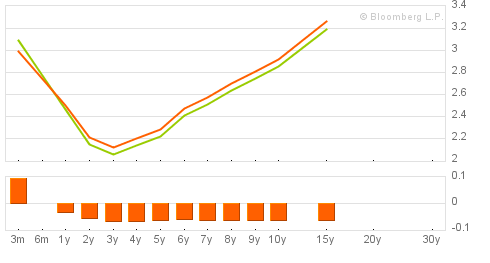
Australian Government Bond Yield Curve – 1 June 2012 – 4.06pm

Source: www.bloomberg.com

The 3 year Australian government bond is currently 2.06%…this is truly extraordinary. When you throw in the fact that Germany, USA, and Switzerland also have record low bond yields its really looking like a serious run for safety…but major equity markets haven’t really moved to the same tune…sure they’ve dropped but there’s lot further to go.

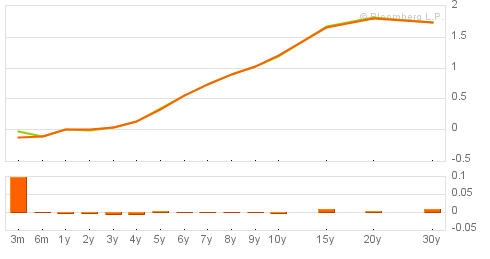
The following chart is the German bond yield curve…yep you see right…negative rates if the term is under 1 year…you pay the government to hold your money!

German Government Bonds (I’m being a bit lazy with my bond jargon)

Source: Bloomberg

To me, this is the bond markets of the world signalling the end of the Euro…the equity markets haven’t quite responded yet…or maybe bond markets are being a tad irrational…who knows. Please excuse my short termism but both asset classes look awful.

So where to put your money in this frightening looking environment…Australian term deposits still continue to be the winner…I saw a 60 day TD offering 5.3% today and you can get 5.2-5.3% for 1 to 3 year terms. At a 3 year term, that’s almost a 3.2% margin over Australian government bonds…that is truly unheard of!

May 30

Australian Government Bond Yields…setting new records

Source: RBA

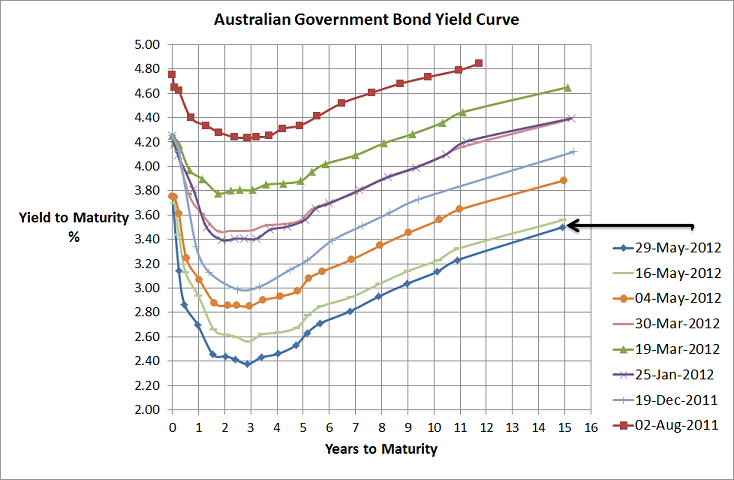
I know I’ve written more posts on the Australian Government Bond Yield than ever but with the yield curve hitting record lows its pretty hard to ignore. The above chart shows where the yields finished yesterday and today they’re lower again.

The European situation is definitely the main driver as funds move to this safe haven. The Australian government is AAA rated, contrary to the spin of the opposition party, Australia does have a very low level of government debt, and given these low risk factors its no wonder these bonds are popular in the face of potential economic calamity.

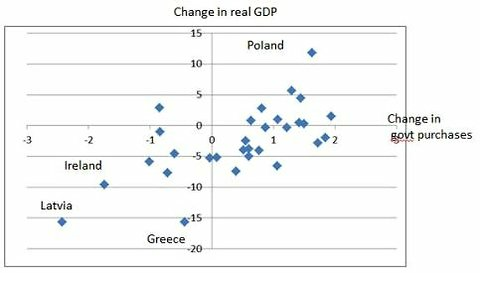
Let’s face it, the Euro is pretty much finished. It might take a while but the Euro experiment is a failure and the requirements to fix it appears too much of a paradigm shift for the Germans and others to save it. The current strategy of a monetary union combined with austerity (with a desire for wage deflation) will only spiral economies into deeper recession. To rescue the peripheral countries from this recession requires a kickstart that can only be achieved with a fiscal expansion (don’t forget the biggest fiscal expansion in history, WWII, rescued the world from the Great Depression) and/or targeted inflation…the complete opposite of the current failing approaches.
Source: http://krugman.blogs.nytimes.com/2012/02/18/austerity-and-growth/

Fiscal expansion controlled from a centralised body is what countries like Australia and USA can do when states are in trouble and the redistribution of wealth is a necessary requirement for Europe to reverse the peripheral countries’ situations…unfortunately I don’t believe a Unites States of Europe can ever get off the ground in the way that is required.

A high inflation target will help reduce the spiralling debts in real terms but when you consider the paranoia around inflation, evidenced by Germany’s hyperinflation history and the ECB’s ridiculous interest rate rises last year, its also very hard to see how this paradigm shift and change in focus will occur.

Greece will exit the Euro and the drachma will be back. That will create significant pain for Greece who will default on everything, the banks who will need recapitalising and the economy which will sink to new lows before growth restarts…at least it will restart earlier than if things continue as is. The big concern though, is that markets will then see the Greek Exit as a possibility for the other peripheral countries, who may ultimately need to exit if the austerity strategy continues, and that’s when the contagion and panic could really begin. Don’t forget that there are trillions and trillions of derivative contracts linked to the Euro and peripheral country debts and noone really knows where the ultimate risk lands. There is a lot of other stuff that is likely to occur and I haven’t even scratched the surface but the bottom line is that Lehman Brothers is not guaranteed to be the biggest contagion event this century.

I know I’ve painted a pretty ugly picture…I hope I’m wrong…but the above scenario is a greater possibility than many realise. Even if I’m wrong, the European situation and ongoing blow-ups still continues for years and years. The downside risk to growth portfolios is currently significant, and the upside potential isn’t that great. I’m currently a strong believer in being underweight equities, and overweight cash (RBA may drop another 50bps) and bonds…but am still a believer in diversification so still holding all major asset classes…and am more than happy to be wrong!


May 25

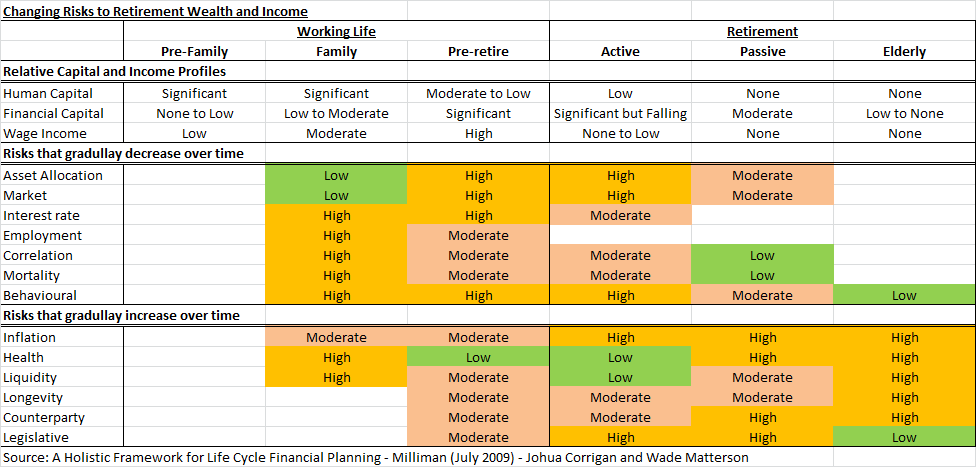
A Heat Map of risks and income for Life Cycle Financial Planning

Found the above heat map in an interesting article on life cycle financial planning on Milliman’s website … click here for the article.

I think the heat map speaks for itself…(although apologies for the spelling errors..my bad)…and clearly points out the risks that generally need to be addressed at various points in time. As the map shows, inflation (and legislative) risks are highest during the retirement years…so portfolios should be designed with inflation protection in mind; (and ideally not rely on age pension or tax concessions etc…easier said then done). Mortality and Health risks are high during the family years…so mitigate that risk with an appropriate level of death, health, income protection and other life insurances. etc. etc.

For the financial planners out there,this table is not a bad tool to be used for any client situation as a discussion point to determine a client’s major concerns and then to design a strategy to address them…and to double check that all risks are addressed.


May 20

Being a millionaire may not be enough for a comfortable retirement

Source: Delta Research & Advisory Pty Ltd

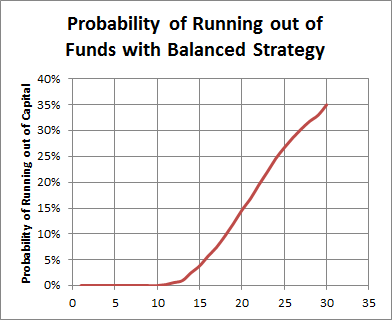
The above chart shows the probability of running out of funds in retirement for someone who retires with $1,000,000 in today’s dollar and draws $55,080 each year (ASFA Retirement Standard for a comfortable retirement for a couple), growing at 3% inflation. It is assumed the funds are invested in a “Balanced” strategy (like most default super funds) with an expected return of 8.5% after fees (which many would say is very bullish) and expected volatility of 13.8%pa (which is probably fair). These probabilities were calculated using monte carlo simulation.

So despite an expected return (8.5%) that is much higher than the drawdown (~5.5%), the probability of portfolio failure (i.e. running out of funds) is surprisingly high. Drawing this amount each year, linked to inflation means that after 30 years there is a greater than one in three chance of running out of funds (~35%). Around a 15% chance (~one in six) of running out of money inside 20 years which is somewhat of a concern given that is roughly a 65 year old’s life expectancy.

The main reason for this high chance of portfolio ruin is the sequencing risk a balanced strategy brings to the retiree. A portfolio which has around 70% invested in growth assets has a reasonably high probability of starting off with a sequence of poor returns (like we’ve seen over the past 5 years). When you throw in the required withdrawals to pay one’s lifestyle the chance of a portfolio recovering after a sequence of poor returns is quite low indeed.

So what to do? Don’t put all retirement income at risk. Work out what the minimum required retirement income is to ensure a minimum lifestyle and lock it in with an inflation linked annuity or bond (if possible). I say inflation linked because inflation is another risk that cannot be removed with a portfolio of traditional portfolio of equities and bonds. There is no point putting one’s minimum lifestyle at risk so lock it in. Over and above that, there may be a need to chase return so that’s where the traditional portfolio of equities and bonds can come into play…surely a retiree would be less concerned about the risky portfolio if they know their basic costs are looked after.

Whilst there much more to portfolio construction in retirement the above steps are certainly a step in the right direction from the current default superannuation fund solutions.

May 18

Australian Government Bond Yields…continue record lows

Source: RBA

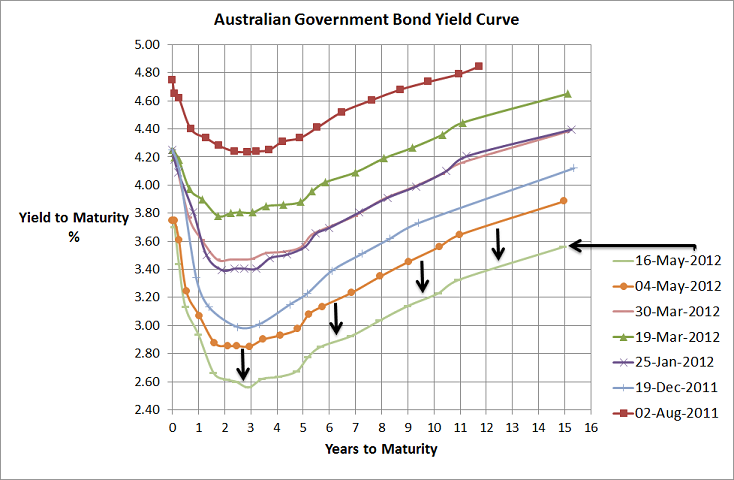
In less than 2 weeks the Australian Government Bond yield curve has dropped another 20bps plus and since August last year, the yield curve has dropped around 160bps on average…which means for bond fund owners double digit returns over the previous 12 months continue.

Obviously the main reason for this drop in yield is the Euro situation blowing up, yet again…and it will continue to blow up over and over for possibly years to come. The search for safe havens is much harder than it used to be and when you consider that the Australian Government Bond is one of the few AAA rated sovereign bonds available its not surprise they’re popular.

The current theme is, and I’ll quote fixed interest portfolio manager Vimal Gor of BT, “investors are looking for return of capital, not return on capital.” This is pretty difficult to argue with when you consider that German 2 Year Government bond yields are yielding 0.04%…you’d have to expect that will be a reasonably negative real return over the next 2 years but deflation is a real possibility.

Oh well, Europe is a disaster zone, its difficult to see that taking on sharemarket risk (whether here or overseas) is worth it given its downside risks are far greater than the upside potential. You can still get 5% for >1 year term deposits so tactically I’m thinking this government guaranteed (up to $250K) investment continues to be the best value around whilst the Australian banks continue to be hungry for local capital. Risk off is a well ensconced theme today and volatility should be high for many months (or years) yet.

May 12

A Slideshow on the European Crisis

Paul Krugman, Nobel Prize-winning Princeton Economics Professor, has placed an upcoming presentation on the European Crisis on his website…please click here.

It is such a simple story as to how badly Europe is going, why it erred, and why to continues to err. Some of the fascinating points in his slideshow include…

  • British GDP has performed worse since the start of 2008 than during the Great depression of the early 1930s.
  • The level of Spanish government debt and fiscal position was much better than Germany’s throughout last decade leading up to 2008
  • what we’ve known for a while but noone seems to care…that Austerity fails with regards to GDP growth and that the problem is a balance of payments problem…not a fiscal problem (Greece being the badly behaved exception)
  • Deflation as a solution, which appears to be Germany’s solution (thanks to their paranoia due to their history of hyperinflation), is many many years of pain.

All of this and more in a very simple slideshow that I ‘m sure I will use parts of in upcoming economic presentations.

May 10

A Few Investment-Related Budget Outcomes

As expected the Federal Budget focused on a surplus and to the government’s credit is looking to distribute some of their mining profits to the not so wealthy. Whilst the opposition is suggesting that some of the cash payments will be going straight to retailers instead of their intended purpose, that’s not necessarily a bad thing given the current weak state of retail…although overseas online retail would not be a good result.

Anyway, following is a summary of some of the investment-related impacts the budget may deliver.

  • The forecast budget surplus opens the way for the Reserve Bank to continue reducing interest rates. With 1 year and 2 year Australian Government Bond Yields at 2.92% and 2.68% respectively, the bond market is expecting the cash rate to be much lower.
  • Higher superannuation contributions tax and other superannuation reductions will increase revenue for government but will reduce investible dollars for the superannuation industry. Impact on markets should be relatively negligible.
  • The government’s decision to remove the previously promised reduction in the corporate tax rate from 30% to 29% is also expected to have negligible impact on markets.
  • Aside from interest rates, the biggest specific investment-related impacts from the budget are in the areas of property and certain gearing related investment…
    • From 1 July 2012, the withholding tax rate on managed investment trusts will double to 15% and will impact non-resident’s investments in property and infrastructure trusts. This may have negative consequences for those trusts reliant upon foreign investors.
    • Non resident investors will no longer have the 50 per cent capital gains tax (CGT) discount for on capital gains accrued after 8 May 2012. This impacts non-resident individuals with Australian property and will possibly impact off-the-plan investment property which does rely on a degree of foreign investment.
    • The plan to offer tax offsets against environmentally friendly buildings is no longer.
    • Finally, the government intends to scrap deductions for assets where the taxpayer is not effectively at risk. This may impact investors who gear into capital protected products or structured products) if the interest is no longer tax-deductible.

May 08

World’s 10 Strongest Banks (by Nation)

I thought this list would have contained at least a couple of Australian banks given their high credit ratings, profitability, and belonging to one of the stronger developed economies of the world. Anyway, the top 10 strongest banks can be found by clicking on the following link…

Bloomberg’s List of World’s Strongest Banks.

or

World’s Strongest Banks (by Nation)

…interesting.

May 07

Australian Government Bond Yields…supports the dumb budget

Source: RBA

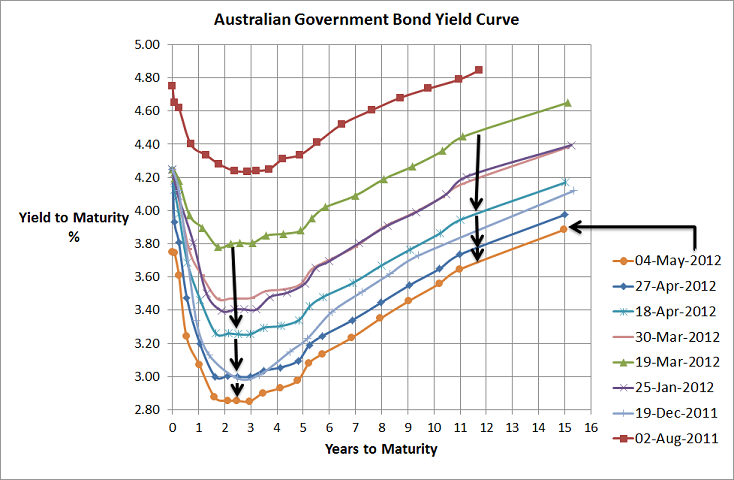
As the above chart shows, the yield curve has dropped 70 to 90bps for all terms since March 19. With a 3 year bond yield just above 2.80%, which is close to where it was during the worst of the GFC, its pretty obvious markets aren’t too confident in the strength of our economy or the quality of tomorrow night’s budget which is highly unlikely to provide a great deal of economic stimulus.

Today we saw Australian equity markets experience their biggest one day fall in 2012 on the back of European election results that have suggested upcoming uncertainty in solving European woes plus more weak US employment data late last week. With continued weakness everywhere, fiscal austerity is not working and there needs to be a change of approach.

The investing environment continues to be very very tough. Interest rates in Australia are very low and equity market volatility has made an appearance to remind us it is still there. Even Australians appear to have lost confidence in the residential property market as it has dropped around 10% over the past 12-18 months. With banks still hungry for capital it appears their deposits still offer the best relative value but even they’re not looking as good as they used to.

Older posts «

» Newer posts