Jun 12

RimSec June Research Report

The RimSec Monthly Research report came out today and can be downloaded here.

Whilst the view hasn’t changed too much…i.e. inflation is low, interest rates across the curve to stay low, thanks to the weakening Australian economy…there’s also a little piece on Japan and their massive fiscal and monetary expansion…if it works it could be a great thing for Australia but the markets are definitely showing some uncertainty about it and fair enough too…let’s face it, if you set a high inflation target its gong to be very difficult to keep bond yields low and high bond yields are dangerous for the most indebted developed economy in the world.

   Send article as PDF   

May 31

Australian Government Bond Yield Curve…plus a bit on lifetime annuities

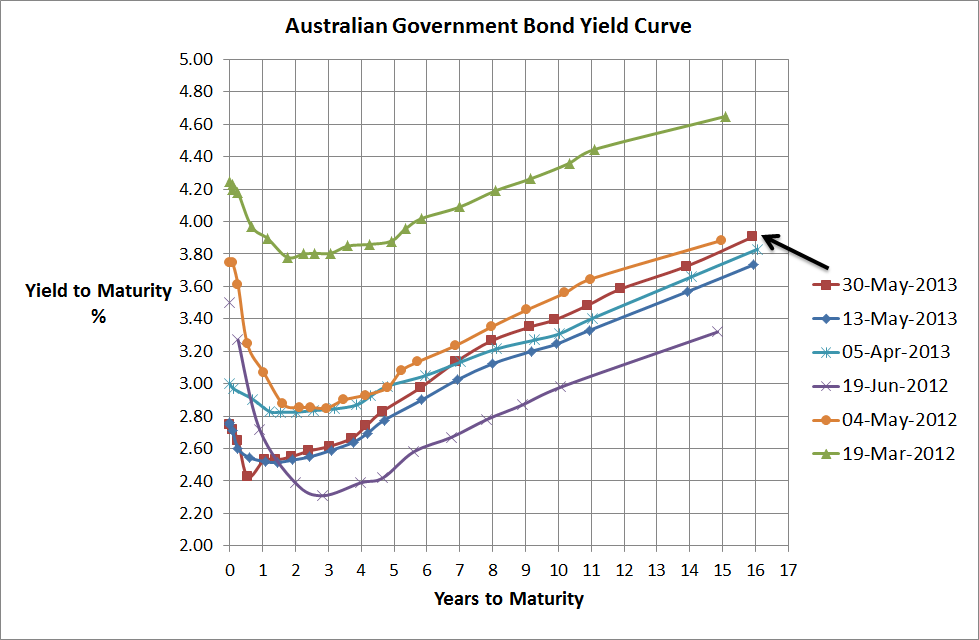
Aust Government Bond Yield Curve - 30 May 2013Source: RBA, Delta Research & Advisory

Not too many posts in recent times and its been a while since I looked at the yield curve and I have to admit that after scanning the various newspapers I was expecting to see some significant moves. As the above chart shows, the curve has barely moved in the past few weeks and most of the move has occurred at the longer maturities…which is often a sign that the longer term outlook for the economy is looking good. I’m not sure that’s the case, particularly when you see the sharemarket correct in recent weeks but either way, the yield curve movement is hardly a sign of the bond market crashing and its really the same old story….yields are low because the outlook for both inflation and the economy is both low and weak, respectively.

I’m sure one of the most frustrating aspects of financial markets is their “risk on” or “risk off” behaviour and the last couple of weeks or so has certainly returned to “risk off”. I’m guessing that after the 20% plus returns of the Australian sharemarket since mid-2012, the retail investor has started to dip the toe only to be hit with a sell-off that has seen the ASX200 index drop almost 6% which isn’t too kind.

Anyway, the term deposit rates are certainly low in nominal terms, relative to the government bonds they are still paying a healthy margin of potentially 200bps or more, and given the US and Japan are still keen to print money you would think risky assets will continue to receive a boost..but the recent mini-correction has shown that it shouldn’t be taken for granted….but I do tend to think the liquidity flow will continue to help sharemarkets until the tap is turned off.

Anyway, there is one instrument that I have not mentioned for quite some time and depending on your age at investment, it is easily the best risk-adjusted return you can get today…and it is the inflation linked lifetime annuity.

Of course, there are numerous risks that I haven’t disclosed such as…

  • liquidity may differ depending on the specific issuer
  • liquidity may be age dependent

which are not the only risks…however…when you consider that a 16 year Australian government bond only yields around 3.9%pa (see above chart), the fact that a female aged 65 can receive a 5% return that increases with inflation every year and still have access to 100% of capital at 15 years into the investment, it doesn’t get much better than that in this low interest rate environment. Lifetime annuities have been forgotten for many years, due to awful liquidity and rates that weren’t terribly attractive no matter what you compared them to…so fair enough…but in recent times this has certainly changed and this product should now be a serious contender for part of a retirement income portfolio… obviously an appropriate analysis of needs and risks must be performed first before any investment to such an instrument!…my very important warning!!!!

Lifetime annuities today have the potential for a premium return over bonds with an inbuilt inflation hedge…which is supposed to be why we use equities in a portfolio but with annuities you don’t get the volatility that equities provides so it should be attractive for many financial planners and certain clients.

   Send article as PDF   

May 14

Rimsec May Research Report

The Rimsec Monthly Research report came out today which has commentary on current investment market themes, interest rate thoughts and some information on one of the significant risks within China…their property bubble. Anyway, if it is of interest you can download it by clicking here.

   Send article as PDF   

May 06

Australian Government Bond Yield Curve…pointing to lower rates

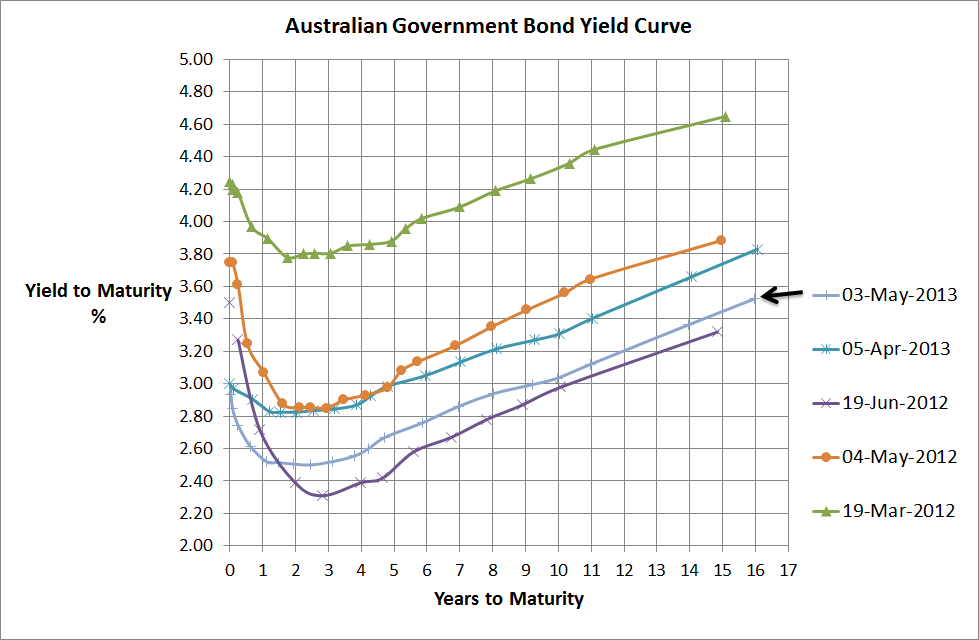
Aust Government Bond Yield Curve - 3 May 2013Source: RBA, Delta Research & Advisory

Whilst there has been so much talk about how funds are flowing out of bonds into equities there is little sign of it in the markets. The above chart shows Australian Government yields near the low levels of last June when the Eurozone was looking like blowing up creating a potential catastrophic scenario.

Over the last month yields have dropped around 30bps and the market is now pricing in two 25bps reductions by the RBA between now and the end of the year. Other juicy pieces of information this chart suggests includes…

  • Bonds are still in demand
  • Inflation is a non-issue for now
  • Longer term economic growth is likely to be weaker than what we’re used to

With a 16 year Australian government bond paying a yield of only 3.5%, it drives me nuts when I hear all of the BS about Australian government debt. I don’t know about you, but if I could borrow at 3.5%pa with the ability to print my own money, I would hardly be concerned about having to borrow money to fund infrastructure spending that can only help the future income prospects of the nation. Both sides of government have painted themselves into a ridiculous political corner on the debt issue and whilst economic growth is certainly an issue thanks to the end of the resources boom, there is nothing with spending some funds wisely to create an economic future of further prosperity.

Anyway, I digress. From an investment strategy perspective, the money printing central banks of the world are ensring that all asset classes are well supported. The risky asset and bond buckets are all fairly full and look out when the US and to a lesser degree Japan switch off the printing press. Until then, its difficult to see anything but continued risk asset growth with stable bond yields.


   Send article as PDF   

Apr 12

Is there a “value” bubble in Australia?

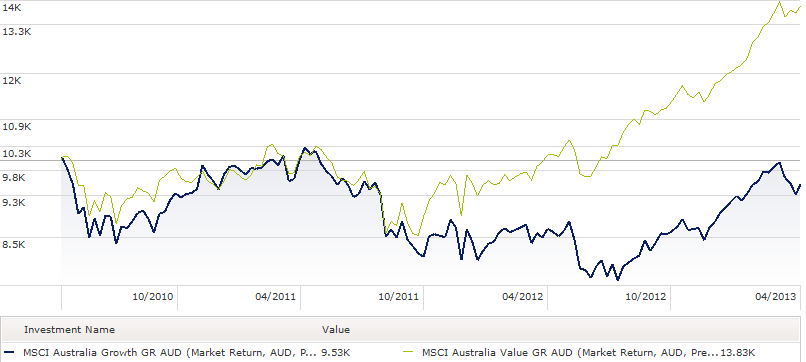
MSCI Australia Value vs Growth - April 2013Source: Morningstar Direct, Delta Research & Advisory

The above chart shows the performance of the MSCI Australian Value GR index vs the MSCI Australian Growth GR index and I’m sure you would agree there is quite a divergence in performance. In fact, as the numbers show over the last 3 years, the Value index has outperformed the Growth index by over 40%!!!, and this outperformance has really only occurred since late 2011. Over the last 12 months, the outperformance is around 26% which is still quite incredible. Over the last 40 years Value has outperformed Growth by around 4%pa so the numbers say a lot.

One of the defining characteristics of the Value index is the size of a company’s Dividend Yield (along with Price/Book and Forward PE Ratio) and I’m pretty confident (well actually i have no doubt) it is the “Chase for Yield” that has driven this outperformance. So whilst I understand this need for yield in the historically low interest rate environment, I can’t help but think that this price movement is a little excessive and there is likely to be some level of convergence of the two indices over the coming few years…obviously I could be wrong, but I’m thinking “short MSCI Value/Long MSCI growth” looks a reasonable likelihood.


   Send article as PDF   

Apr 12

A Couple of Market Outlook Reports (JV w RIMSec)

I’m a little late with the first one of these but the second is hot of the press, so to speak. The following links are Market outlook reports provided by Rim Securities, and written by yours truly for Delta Research & Advisory.

The March update (that is only 2-3 weeks old) can be downloaded here; and the April update can be downloaded here. Please note, it does have more of a fixed income focus.

We should be seeing some further Euro concerns in the short term (Portugal) and Abenomics in Japan is certainly creating a bit of interesting sharemarket, bond market and currency movement right now…in fact the Australian dollar is at a record high on trade-weighted terms which is not good for Australian exports in the short term but if Abenomics gets the results long term then it will provide an improved blueprint for Europe to work off.

   Send article as PDF   

Mar 30

Australian Government Bond Yield Curve…still well supported

Aust Government Bond Yield Curve - 27 Mar 2013Source: RBA, Delta Research & Advisory

The above chart shows that the Australian Government Bond Yield Curve really hasn’t moved that much in the last 3 months…around an increase of 20bps which is not much at all when you consider all the talk about switching from equities to bonds.

The reality is that there has not been any switch from equities to bonds, just that all of the money printing from central banks around the world need to find a home and that home is the risky assets; equities, credit, commodities; and currencies such as the Australian dollar.

The bond yield curve above shows that yields stay between 2.8% and 3% out to a term of 4 years, so the market is essentially saying the Reserve Bank will keep rates on hold on Tuesday and it should stay that way for a few years yet. At most, there may only be one more decrease by the RBA and that may occur later in the year if at all.

Moving forward whilst the US, Japanese, European, UK, and Swiss central banks continue to print money the above-mentioned risky assets will probably be well supported (Europe’s problems will add to volatility) but as we’ve seen over the last 3 months or even 12 months, I don’t expect yields to move significantly unless there is a serious upward surprise in inflation…and that appears quite unlikely at the moment so no bursting of the bond bubble yet….just continued low returns.


   Send article as PDF   

Mar 06

The most powerful financial planning tool

The process of financial planning is like any planning process…

  1. you find out where the client is positioned today,
  2. work with the client to establish goals whilst
  3. understanding the constraints to reaching those goals, and then
  4. design, present and implement a strategy to reach those goals…which is then
  5. reviewed on a regular basis..therefore go back to Step 1.

There is one very simple tool that can contribute to efficient answers to each step…but it rarely gets the detailed attention it deserves…the expense budget.

A detailed understanding of an expense budget can provide all of the following information with far greater clarity than without it…

  • calculate excess savings…which can be used for tax effective salary sacrifice to super or simply a savings plan outside of super
  • understand discretionary expenses that can potentially adjusted to provide for greater excess savings, and finally and most powerfully,
  • understand the true cost of basic lifestyle and desired lifestyle which can be then used to calculate a retirement income goal

So the expense budget actually provides some for the answer with regards to the client’s current situation (i.e. expenses…der); constraints (i.e. savings limits) and then the calculation of goals (i.e. base and desired lifestyle cost which can be used for retirement income).

Possibly the most asked question in financial planning is, “how much money do I need to retire?” and a detailed expense budget can provide this…you can exclude all of the expenses that are unlikely to be present in retirement (education costs, mortgage, etc); and then add in a couple of retirement costs (additional healthcare and holidays) and using that figure using lifetime inflation linked annuity rates can provide the goal in today’s dollars. Of course, you may believe you can achieve the retirement income goal with a smaller amount but you can hardly provide a guarantee like a life company can and I’m not suggesting investing in lifetime annuities…just using their rates for retirement asset goal purposes…so inflation linked lifetime annuities it is.

Then the strategy becomes a matter of mathematics whereby you work out the current retirement assets, current savings potential, and using the retirement income goal(s), the planner can calculate the required annual return for achieving that goal(s). Once that rate is determined, then an appropriate investment strategy can be designed…therefore providing an efficient goals based strategy for recommendation.

The final step is the ongoing client review, whereby the initial inputs are reviewed, and if the required rate of return increases or decreases then the investment portfolio can be adjusted accordingly…as far as I’m concerned no need to accept greater risk than necessary to reach goals…so an efficient solution is recommended at each review. Keep in mind as interest rates change so too will the amount of assets required to provide an inflation linked after tax retirement income…therefore the goal is a moving goal and it must be continually recalculated.

If these steps are taken, then investment strategy becomes a matter of simple design using current interest rates and mathematics, based on needs first with the chase for higher returns, via which asset class will outperform, can become a secondary issue. Oh yeah…the risk profiling is used simply to ensure the client has the tolerance, understanding  and capacity to follow the strategy. What a simple way of differentiating a client solution.

   Send article as PDF   

Feb 15

Global Returns Yearbook

One of my favourite reports has just been released, Credit Suisse Global Returns Yearbook. Aside from showing long term investment returns from the major exchanges around the world there are some fascinating articles on some of the latest thinking that relates to investment considerations. This year the articles are…

  • The low return world
  • Mean reversion, and
  • Are equities a good inflation hedge.

A couple of the fascinating charts for me (and possible noone else) include…

China

Chinese Asset Class Performance


Certainly the Chinese sharemarket has produced very poor real returns since the 1990s…so much for economic growth contributing to sharemarket growth.

World

World Asset Class Performance


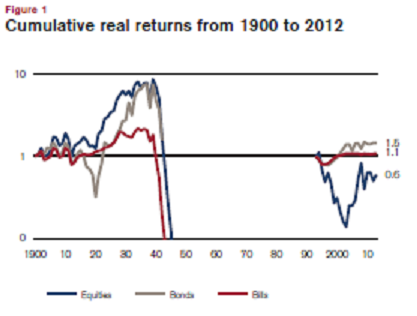
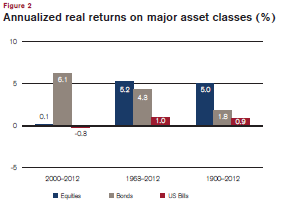
Over the last 112 years, shares have outperformed bonds by only 3.2%pa…that certainly compounds to a massive difference but I’m guessing its way below the expected outperformance many advisers or clients expect to receive for accepting the additional sharemarket risk.  Oh yeah, and I’m being positive from this graph because over the last 50 years that outperformance was only 0.9%pa … albeit bonds have had a great run which I’m very confident cannot continue for the next 50 years.


   Send article as PDF   

Feb 11

A quick look at equity and bond markets

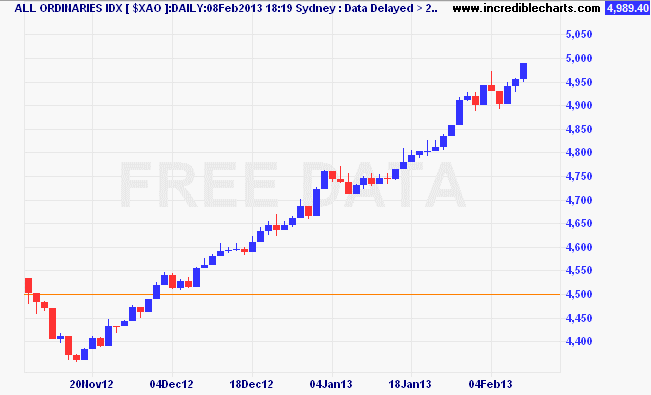
All OrdsSource: www.incrediblecharts.com

As the above chart shows the Australian Sharemarket has had a stellar run over the last 3 months. Not a hint of volatility just upwards she goes from around 4350 to just short of 5000…throw in a very small number of dividends and its a superb return.

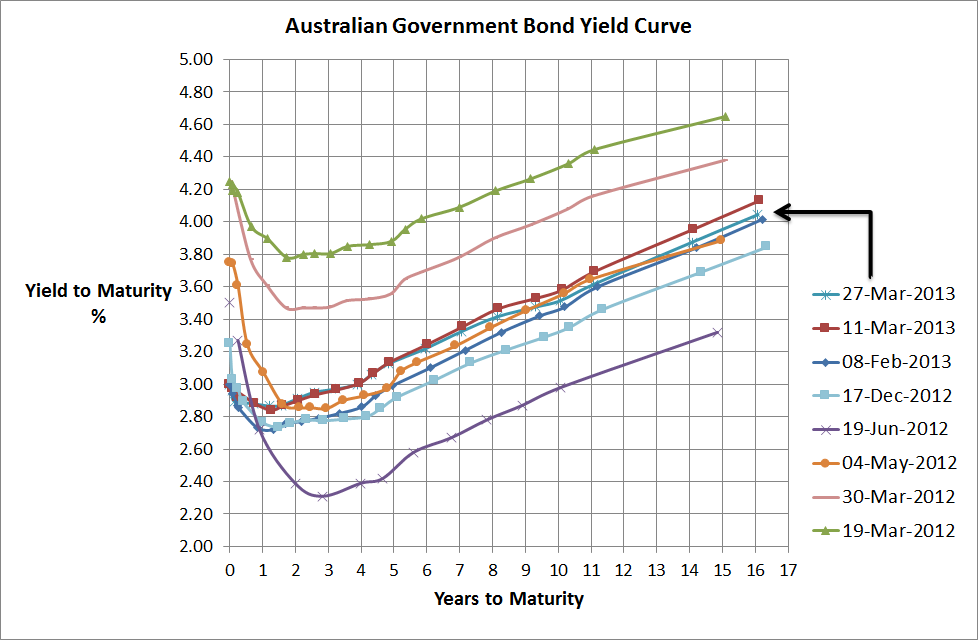
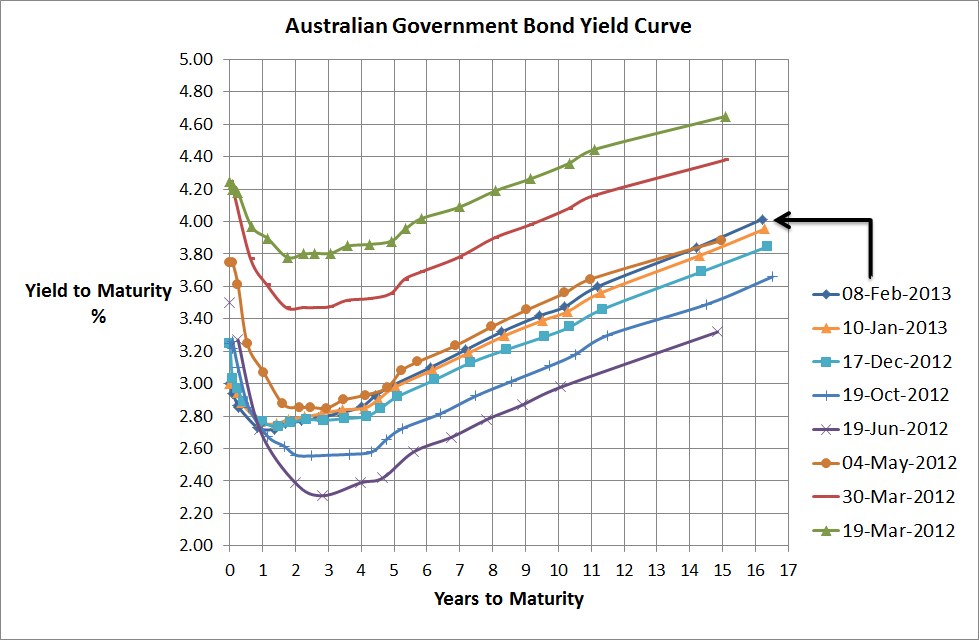
Newspaper talk has suggested that there is a switch out of bonds…the following yield curve does show that bond yields have increased, it pales in comparison to the run-up in the sharemarket. In fact, the yield curve is still trading in the same trading range it has followed since May 2012.

Aust Government Bond Yield Curve - 8 Feb 2013Source: RBA, Delta Research & Advisory

So will bonds eventually take a tumble (i.e. yields rise sharply)? It is certainly possible, but there are many factors keeping yields at low levels. Some of these include…

  • Overseas demand for AAA rated debt…the Australian government is one of the few AAA rated sovereigns and contrary to what th opposition government says, Australian also has amongst the lowest debt levels in the world
  • Australian government bonds are still yielding very high compared to other developed nations so assuming a relatively stable Australian dollar…this still makes our bonds attractive to overseas investors
  • A deleveraging consumer…household savings rates in Australia continue to be over 10% of household income
  • Baby boomers retiring and de-risking their portfolios…the baby boomers only started retiring at age 65 last year and moving their savings into safer fixed income products is a phenomenon that has many more years to play out
  • tougher regulations on financial institutions resulting in their need to set aside greater levels of capital in safe bonds

These reasons are just off the top of my head and I’m sure there are several more I haven’t thought of. Suffice to say, the sharemarket’s run has been amazing and surprising in the face of declining expected earnings, fiscal cliff , and a bearish RBA (albeit Europe has calmed and QE has helped); bonds have held firm and are unlikely to collapse any time soon (which is not to say they won’t go down as they might), so where to invest your money? I’m afraid I’m always going to have to go back to two old investment rules and risk being ultra-boring…diversify and invest for the long term…market timing is too tough a gig.

   Send article as PDF   

Older posts «

» Newer posts

Follow

Get every new post on this blog delivered to your Inbox.

Join other followers: